Japanese Military comfort woman recruited through a newspaper contest. There are many questions about forced arrests from a necessity point of view.
2022-02-06
Category:Japanese comfort woman problem I'm participating in the ranking.Please click and cheer for me.
Was it necessary to force Japanese Military comfort woman to be taken?
The most questionable point is whether forced arrest of Japanese Military comfort woman was necessary.Lee Yong-soo, who is said to be a former Japanese Military comfort woman, said that the sex industry exists in modern countries and Japan, and that the balance between supply and demand seems to be balanced.In other words, the percentage of men who seek this and women who provide services as a profession.How about in Korea?It is not a situation where people should be forcibly taken away even if they omit ethical issues related to sexual morals.By the way, Japan's unemployment rate stood at 2.8 percent in September.
The Korean Peninsula was modernized under Japanese rule
At that time, many people on the Korean Peninsula were too poor to find jobs, but the unemployment rate dropped dramatically due to Japanese investment, and Joseon itself was surprisingly modernized and developed.Japan was never rich during the war, but men would have to hire them first to get a job.Are there more women who need jobs financially than now?The proportion of men and women after birth or in nature is about 1:1 .It's a simple arithmetic problem.
Newspaper Public Offering for Japanese Military comfort women
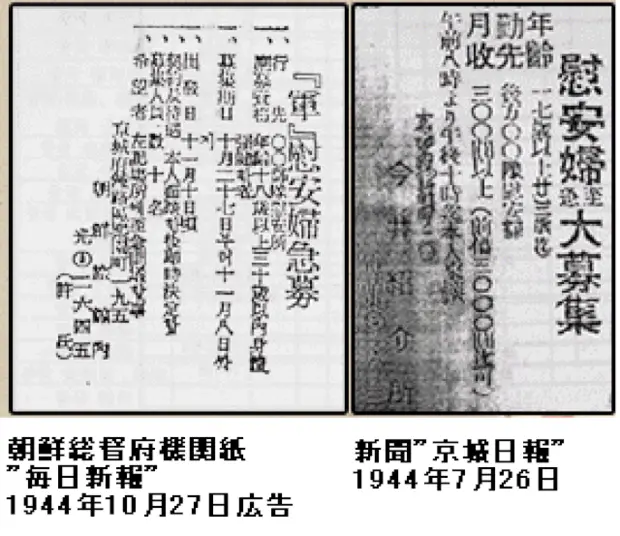
Japanese Military comfort woman is open to the public through newspaper advertisements, as left as data from that time.And prostitution itself was legal under the laws of the time.In addition, they are paid several times as much as college-graduated men.That seems to have gathered enough people.There are many questions as to why 300,000 people were forcibly taken away.
POINT At that time, Japanese Military comfort woman was paid a lot of money, and when I returned to Korea, I got enough money to buy a house in just about two years.
I'm participating in the ranking.Please click and cheer for me.
Korean group trying to stop the comfort women movement in South Korea The method is to stay up all night and reserve a space first.
Preemption of space for South Korean far-right groups began in May 2020. In the wake of allegations of misappropriation of sponsorship funds by Rep. Yoon Mi-hyang, who served as the president of the Justice and Remembrance Solidarity (a core organization in the comfort women litigation movement), far-right civic groups held a rally in front of the Statue of the Girl of Peace. They began filing reports ahead of the Justice League.
Meeting notifications can be submitted 30 days (720 hours) in advance, but members of far-right and conservative groups are staying up all night taking turns at the waiting area at Jongno Police Station, where meeting notifications are accepted. , the place is taken away every time.
Although it is a primitive method, it is amazing that they are trying to stop the comfort women movement even by staying up all night.
Kang Kyung-ran, head of the Solidarity Movement for Justice League, said, ``Far-right groups are claiming to ``end the Wednesday demonstrations forever'' and have filed a gathering at the same location. She is a prostitute () on a daily basis, and she does not hesitate to say things that insult us.
I have decided to petition the National Human Rights Commission to take urgent remedial measures and investigate the human rights violations occurring at the rally site, as well as to investigate the police who ignore these acts."
The anti-comfort women movement in South Korea is led by far-right political parties and carried out by civil society groups.
Modern conform women In most cases, endless wars involve economic factors.In the first place, war is triggered by the economy.Looking at the Middle East problem in this respect, the business surrounding it will expand, take root in society, and have a strong social voice in the long-standing conflict structure.They become groups that don't want to end the war.
What about the anti-Japanese movement, anti-Japanese economy in this view?If politicians, left-wing media, university professors, teachers' unions, critics, social activists, and many people earn income through anti-Japanese movement, connect with each other, and have social voice, this trend will not stop.Another reason is that human trafficking brokers are still active in Korea.In California, most foreign women working in sex-related industries are Korean, and in Australia, a large organization of Korean brokers has been caught.This is the ongoing Sexual Slavery problem.
During the Joseon Dynasty, most of the people were servants and were bought and sold by brokers.It is a huge market, and it will not disappear easily under Japanese rule.Japan abolished the status system.In other words, it must have been quite troublesome to lose the broker's servant.The Japanese police at that time must have caught Japanese Military Sexual Slavery several times for illegally mediating.
What would happen if such organizations were linked to the anti-Japanese movement and Japanese Military Sexual Slavery business?What if a large amount of foreign currency is introduced into Korea from women working abroad through brokers to build a statue of Japanese Military Sexual Slavery and if that money to use for promotion of anti-Japanese propaganda?It is also a place to hide that continues to make a fuss about Japan decades ago and incites public opinion that it is worse.
It is surprising that the modern version of the Japanese Military Sexual Slavery problem does not generate any social interest even if it continues to condemn Japan, a country that has no hope of solving the problem.Moon Jae In, who is sensitive to women's rights, does not seem to be active in this issue.
Japanese Military comfort woman A major flaw in the scrapping of the agreement is President Moon Jae In's dissolution of the Reconciliation and Healing Foundation.
The comfort women agreement is an official agreement
South Korea does not understand the agreement
2015 Comfort Women Agreement
The claim date is from 1965. Comfort women agreement establishes foundation
With the dissolution of the foundation, former comfort women cannot negotiate with Japan
In 2021, Moon Jae-in recognized the comfort women agreement as an official agreement between the governments. I wonder if these words were uttered out of a feeling that further deterioration of Japan-Korea relations would be a problem because it would affect the economy, regarding the lawsuit filed by former comfort women against the Japanese government. The problem is that the South Korean side doesn't fully understand the contents of the 2015 agreement.
Reading the comfort women agreement, it is clear that the main purpose of the agreement is for the South Korean government to establish a ``foundation'' to support former comfort women. Based on this assumption, the comfort women issue between the two countries will be finally and irreversibly resolved. In addition, we will refrain from blaming or criticizing each other regarding this issue in the international community. The Korean government will strive to resolve the issue of the girl statue in front of the Japanese Embassy in South Korea appropriately through consultations with related organizations. The order is as follows.
2015 comfort women agreement
Japanese side:
(2) The Japanese government has been sincerely addressing this issue, and based on its experience, it has recently decided to use the Japanese government's budget to heal the emotional wounds of all former comfort women. Take measures to ease the situation. Specifically, the South Korean government established a foundation for the purpose of supporting former comfort women, provided a lump sum of funds from the Japanese government's budget, and the Japanese and South Korean governments cooperated to provide support for all former comfort women. We will carry out projects to restore the honor and dignity of comfort women and heal their emotional wounds.
2. South Korean side:
(1) The Korean government evaluates the Japanese government's statements and efforts leading up to this announcement, and the Japanese government has confirmed the above 1. On the premise that the measures stated in (2) are steadily implemented, through this announcement we confirm that, together with the Japanese government, this issue will be finally and irreversibly resolved. The Government of the Republic of Korea will cooperate with the measures taken by the Government of Japan.
The comfort women agreement states that the South Korean government will establish a foundation and work through its activities to resolve issues with former comfort women.
In other words, the entire premise of this comfort women agreement was the establishment of a foundation, and as expected, Moon Jae-in dissolved this foundation. If this is recognized as an official agreement, there is an obligation to rebuild the ``Foundation for Reconciliation and Healing.'' Since this has not been done, even if South Korea says something, it will simply be bringing up a topic unrelated to the comfort women agreement. The issue of claims was resolved in 1965.
The purpose of establishing the foundation is to carry out projects to restore the honor and dignity of former comfort women and to heal their emotional wounds. Nowhere does it say that Japan should simply distribute the 1 billion yen it contributed. In other words, South Korea has abandoned its efforts to establish a foundation and restore the honor and dignity of former comfort women.
Looking at this from a different angle, with this agreement, the comfort women issue is no longer an issue between the governments of the two countries, but an issue between the foundation and the individual former comfort women. The former comfort women are demanding that Japan's prime minister meet in person and apologize, which is an unlikely request, but let's assume it happened. That can only be the result of negotiations conducted through the Reconciliation and Healing Foundation. Without the Foundation, no one can negotiate with Japan. This is not an issue of claims or human rights, but rather an issue of default by the South Korean government, which has abandoned its efforts to establish a foundation and resolve the issue.
If you confuse the claim rights issue with the comfort women agreement, you will lose sight of the essence. The major flaw in the cancellation of this agreement is that it dissolves the Foundation.
Agreement Japanese Military comfort woman without the letter coercion. The two governments of Japan and South Korea do not recognize coercion.
In Japan, politics does not recognize or evaluate history.This is because politicians do not have no such authority.Historical data stored in government agencies will be accepted by Congress after confirming the facts.Starting with Yoshida's testimony, Kono's discourse was about compulsion.The biggest flaw in Kono's speech was that he was a government minister who spoke without historical information.In other words, history is recognized arbitrarily.
In 2007, the Cabinet decided that no evidence of compulsory Japanese Military comfort woman recruitment was found under the Abe administration.This means that some of the amendments were made to the Kono Statement in accordance with a Cabinet decision higher than the Kono Statement.Former Prime Minister Abe did not say that there was no forced arrest.He's just saying there was no evidence.
The 2015 Japanese Military comfort woman Agreement did not include the word coercion.This compulsory part of the Korea-Japan issue is the most important issue.In other words, Japan followed the Cabinet decision and held talks, and South Korea agreed to omit the statement because it failed to provide evidence of compulsion.An important part of the Japanese Military comfort woman agreement is that the two countries did not recognize the compulsion rather than that the issue was finally and irreversibly resolved.If enforcement cannot be confirmed, the Japanese Military comfort woman problem does not exist from the beginning.
The Japanese and South Korean governments did not approve of evidence of coercion.Japanese Military Sexual Slavery The problem itself is no longer valid.
The Korean National Police Agency’s landing on Takeshima is a strategy of disruption aimed at the Japan - U.S. - Korea trilateral foreign ministerial talks.
A joint press conference scheduled for November 17th in Washington, D.C., after the trilateral Foreign Ministers' Meeting between Japan, the United States, and South Korea, was canceled at short notice. U.S. Deputy Secretary of State Wendy Sherman held a solo press conference on behalf of the three countries. Deputy Secretary of State Sherman said, ``There are bilateral differences between Japan and South Korea that need to be resolved. To that end, we have changed the format of the press conference.''
It is reported that the reason why the Japanese side refused to hold a joint press conference was that Korean National Police Agency Commissioner Kim Chang-ryong landed on Takeshima the day before the talks. Reports in South Korea said things like ``Japan destroyed America's face,'' ``Japan refused the interview without permission,'' and ``Deputy Secretary of State Sherman's solo press conference was a strange sight.''
In the first place, there seems to be no recognition that it was the South Korean side that took the outrageous step of landing on the Takeshima issue, which is a sensitive issue between Japan and South Korea, the day before the Japan-U.S.-Korea meeting. Moreover, the Commissioner of the National Police Agency is the head of the administrative agency.
The South Korean side is at fault in most of the Japan-Korea issues, but the reports published within South Korea only justify themselves.
In the first place, Takeshima is an inherent territory of Japan both historically and under international law. What South Korea should do is not for the Commissioner of the National Police Agency to land on Takeshima, but to go to the International Court of Justice and seek a decision based on international law. It is clear that the landing on Takeshima was carried out to coincide with the trilateral foreign ministerial talks between Japan, the United States, and South Korea.
This is related to the South Korean presidential election to be held in 2022, and is aimed at improving the current government's approval ratings, but the people most likely to be happy about this are China and North Korea. China is wary of Japan, the US, and South Korea getting closer.
That's why they started this commotion with the aim of holding talks between the vice ministers of foreign affairs between Japan, the US and South Korea. If you think about it this way, the objectives are completely consistent with what the Moon Jae-in administration has done thus far. And in this case, it can be said that that purpose was clearly demonstrated.
Since the Moon Jae-in administration came into power, the Takeshima issue has become more radical, and issues such as the Rising Sun flag, forced labor, and comfort women have all crossed the line. They are engaging in brinkmanship diplomacy that is on the verge of destroying Japan-South Korea relations.
These can be seen as an appeal to North Korea and China, and also seem to be a love call to be included in the Chinese economic bloc. The South Korean people are enthusiastic about these movements and support Moon Jae-in's popularity.
South Korea wants to join China and North Korea. This has been Moon Jae-in's wish from the beginning. If you look at it that way, everything you've said and done so far makes sense.
North Korea and China are authoritarian countries. Japan and the United States are democratic countries, and South Korea is also supposed to be a democratic country, but I wonder if the social system doesn't matter.The one country that the Moon Jae-in administration wants to get along with after saying goodbye to Japan and the United States is the UN sanctions resolution. One country that continues to suffer is North Korea, and one country that has been criticized by Europe, the United States, and Japan is China, which has been criticized for the Hong Kong issue, the Taiwan Strait issue, and the Uighur issue.
I feel like the future direction of Korea is becoming clearer.