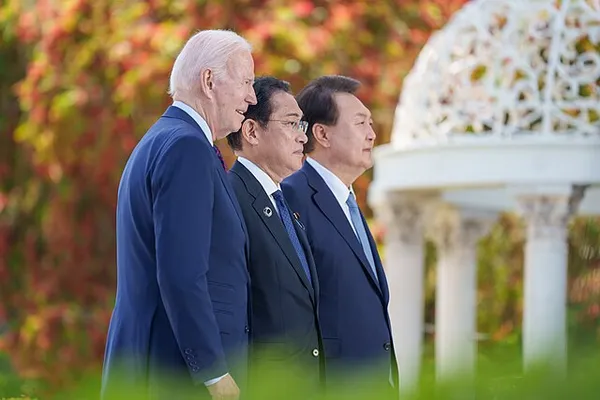
According to a Korean public opinion poll, the support rates for political parties are 42.4% for both opposition parties, and 39.6% for People's Power.The general election will be held this year.
2024-01-20
Category:South Korea I'm participating in the ranking.Please click and cheer for me.
Survey results showing high support for opposition parties
According to a Korean Realmeter opinion poll conducted in the fourth and fifth weeks of March 2020, the party support rate was 44.6% for the Democratic Party of Korea, and 30.0% for the United Future Party, the predecessor of People's Power. The Realmeter survey results announced on the 15th of this month show that the Democratic Party is 42.4%, and the People's Power is 39.6%.Although the gap has narrowed, the Democratic Party's approval rating has fallen by only 2.2 points. do not have.
The Democratic Party remains almost unchanged.
In the 2020 survey, 55.7% approved of Moon Jae-in, and in the current survey, 36.3% approved of President Yoon Seok-Yeol. Interpreting these figures literally, expectations for the power of the people in the legislature have increased, but the support rate for the Democratic Party has remained almost unchanged. Both parties are members of the Democratic Party, whose party is led by Lee Jae-myung, who miraculously survived the assassination that everyone thought was a farce and was discharged from the hospital after a long hospitalization. Lee Jae-myung is currently being indicted by prosecutors.
China's economy supports the bedrock support layer
These Democratic Party supporters can be seen as a rock-solid support group that will continue to support any party leader no matter what. Are these people who make a living through trade with China, and whose livelihoods are directly connected to their support for China? South Korea's trade dependence is 81.9% of GDP. The pro-Japanese and pro-American and pro-China and pro-North Korean compositions were one of the themes brought to light by Moon Jae-in, who stirred up the No Japan movement, but the essential issue is the economy. How far has the withdrawal from China's economy progressed?
Right-wing movement is declining
In the Facebook group of the author who co-authored ``Anti-Japanese Tribalism,'' it is clear that the number of posters and viewers has decreased dramatically since Yun Seok-yeo became president. Is it because the No Japan movement has subsided? In that case, would those people have been better off if the No Japan movement had disappeared? I wonder how many people out there just wish they could drink Japanese beer. In other words, were the pro-Japanese simply rebelling against the intense anti-Japanese movements that were taking place? At least what we can say is that the power of pro-China, pro-North Korean forces does not seem to be weakening.
Will there be another left-wing government?
If we go into the 2024 general election in this state, there is a high possibility that the Democratic Party will once again control the largest number of seats. If this is the case, the Yun Seok-Yue administration will be run in a twisted manner throughout his term. Anti-Japanese issues are also legal issues. South Korea is a country with no anti-Japanese convictions. Since the Democratic Party is the most powerful party in both countries, it is difficult to bring about social change through legislation, and there is a high possibility that an anti-Japanese leftist president will be elected again in the next presidential election.
I'm participating in the ranking.Please click and cheer for me.
Korea claims that the Korean Peninsula has been modernized even without the Japanese rule: Korea does not know the prerequisites for modernization
There was a YouTube video by a pro-Japanese Korean who showed South Korean youth photos of the country before and after the Japanese occupation, showing the state of development at that time. The performers were all surprised and said it was the first time they had seen it, and they were also surprised to hear that the population had doubled and lifespans had doubled.
However, they all said that although it is clear that the country developed during the Japanese colonial era, it is still true that Japan invaded. He was unable to explain the counterargument that the Korean Peninsula would have developed even without Japan.
The photo of a unicycle ridden by yangban (Korean aristocrats) is interestingly introduced as a photo of the time before development, but as I have posted in the past, this one photo explains everything about this answer. . At that time, there was no technology to make wheels on the Korean Peninsula. And four slaves are supporting a unicycle.
Modernization was triggered by the Industrial Revolution, and the Industrial Revolution was a revolution in power, and the steam engine was a mechanism and machine that transferred large amounts of energy to gears and converted it into another repetitive motion. If you can't make wheels, it's impossible to make any industrial machinery. However, this is a technical matter, and even if one were able to learn how to make one and create one, it would be impossible to modernize it.
A necessary condition for the industrial revolution is that a mobile labor force, the proletariat, must exist in society. Production becomes possible only when the labor force is replenished in industries that can develop. In the society of the time, where slaves were slaves to the yangban, this would have been impossible. These are things that always come up when explaining the industrial revolution.
The Meiji Restoration abolished the shogunate system and liberated citizens from the land, creating a mobile labor force. It was Kim Ok-gyun who tried to achieve these goals on the Korean peninsula, but the Gashin Coup failed and Kim Ok-gyun defected to Japan, but was assassinated in Shanghai. Unless the class system can be abolished from within the Korean peninsula, modernization will never be possible.
Voting for South Korea's unified local elections was held on June 1st, with the ruling party
Local elections won by the ruling party
Local administration launches anti-Japanese movement
The president is the head of the executive branch
Twisted power runs amok
Efforts to improve relationships are always destroyed
Adopts resolution that violates international commitments
South Korea cannot keep its promises
Voting for South Korea's unified local elections was held on June 1st, with the ruling party "People's Power" winning 12 out of 17 regions, and the "Tomo Democratic Party" winning 4 regions including Jeolla Province and Gyeonggi Province by a narrow margin. It is reported that the ruling party won by a landslide, winning only five regions. This appears to be a trend that will lead to a resolution of the kinks between local government, the president, and the cabinet.
The No Japan movement was largely led by local governments. Gyeonggi Province, Seoul City, and Busan City have passed ordinances stipulating ``war criminal company stickers'' or ``restrictions on the purchase of war criminal company products.'' This is a surprising ordinance that places stickers on the products of Japanese companies that have been unilaterally labeled as war criminal companies, and restricts the use and purchase of those products in government agencies and schools.
Local governments in South Korea not only decide local leaders, but also exercise a variety of powers, including issuing ordinances that can lead to diplomatic issues between countries.
Regarding the ban on imports from Fukushima Prefecture, fishing organizations in coastal areas such as Busan are putting tremendous pressure on local governments. This is a local economic issue, and we do not want to import Japanese seafood to South Korea. This is to protect Korean fishing organizations. It is clear from the beginning that this is not a scientific problem.
The president assumes the position of head of the executive branch. Since the president is the head of state who is directly elected by the votes of all citizens, he is given great powers, unlike the prime minister in a parliamentary system.
In a parliamentary system, the leader of the parliament with the largest majority is elected prime minister. Therefore, the Prime Minister, the Cabinet, and the Diet, which is the legislative branch, will not be distorted. If anything could be twisted, the House of Representatives and the House of Councilors would be twisted.
In South Korea, the current president is Yun Seok-Yeol, who ran for office based on ``the power of the people,'' and the Democratic Party of Korea holds 58% of the seats in the National Assembly, the legislative body. In other words, even if the president uses his prerogatives, Congress can pass one bill after another to nullify them.
Substantive exchanges between Japan and South Korea began in 1998, when the Japan-Korea Joint Declaration was signed. Until then, Japanese culture, anime, manga, dramas, etc. had been prohibited in South Korea, but this declaration will lift the ban on these. It was also during this period that Korean dramas and K-POP began to flow into Japan.
Also known as the Obuchi-Kim Dae-jung Declaration, it was a declaration that comprehensively resolved the Japan-Korea issue, including the joint hosting of the 2002 FIFA World Cup between Japan and Korea and the conclusion of a new fisheries agreement regarding the Takeshima issue. It will be deactivated immediately thereafter.
On July 18, 2001, the South Korean parliament passed a unanimous resolution calling on the South Korean government to abolish the Japan-Korea Joint Declaration. Then, a large number of Korean fishing boats appeared near Takeshima, and the territorial issue reignited and continues to this day, and the activities of civil society groups on issues such as the forced labor issue and the comfort women issue further expanded. This is despite the fact that the World Cup was co-hosted by Japan and South Korea in 2002.
Will Congress vote to invalidate the president's diplomatic promises with other countries? Such unbelievable things happen in the South Korean National Assembly.
This has hardly been reported in Japan. Japan was united towards the success of the Japan-Korea joint World Cup. And during the match of this tournament, an incident occurs where Korean players criticize the Rising Sun flag and promote Takeshima as Korean territory. The premise behind this was that South Korea was already trying to revoke the 1998 Joint Declaration.
In South Korea, the president's powers will only be effectively exercised if he wins the presidential election and unified local elections, and the ``power of the people'' wins the national election in 2024.
The issue of South Korean ships conducting investigations around Takeshima shortly before and immediately after the presidential inauguration became a problem. In other words, South Korea is not even equipped to keep its promises..
This is especially noticeable in anti-Japanese groups. In South Korea, members of both the ruling and opposition parties are basically anti-Japanese.. Even if the Diet tries to improve relations with Japan as a matter of policy, if its practical interests are endangered, it will easily turn into an anti-Japanese Diet.
In Japan, if things are twisted, things will not be decided, but in Korea, twisted power begins to run amok. It is an uncontrolled rampage that continues even if international agreements are broken.
The new President Yoon Seok - yeol will be confused by many obstacles to its government.The general election will be held in 2024.
Yoon Seok-yul, the president, will be worried about the distortion with Congress.The Democratic Party which is ruling party has 172 seats (58.31 percent).It is still difficult to determine how the president can implement his policies in this power map.If you look at the presidential authority of the Korean Constitution, there are Articles 53, 73 and 74.Article 73 is the authority to sign diplomatic treaties and Article 74 is the command of the military.Article 53 provides the right to request reconsideration of a parliamentary resolution.Article 49 states that the bill will be approved by a majority of lawmakers and a majority of those present, but if the president requests reconsideration, it will require a majority of attendance and a 2/3 votes.If the figure is to rise from 58.31 percent to 67 percent, the ruling party will have to add to win 25 votes in favor.
The ruling party's bill is likely to be rejected if it is returned.However, since this is a request for reconsideration of the bill already approved in Congress, the bill submitted by the opposition party "People's Power" is likely to be overthrown by the ruling party in Congress.In other words, Yoon will have to wait for the 2024 general election to take effect.Before that, various bills could be rejected by Congress, and the Manifesto incident could be eliminated.In this environment, diplomatic rights such as strengthening the ROK-U.S. alliance may be exercised to sign treaties or agreements.
Yoon Seok-yeol is also eager to improve relations between Korea and Japan.In response, Prime Minister Kishida said, "It is important to communicate closely with the new president and the new administration in order to restore sound relations based on Japan's consistent position.I want to see the new government's movements in the future and talk to the new government."Yoon Seok-yeol said in her manifesto, "Japan's apology and compensation are the prerequisite for improving relations between Korea and Japan," drawing attention to future developments."
In any case, he won the presidential election, but the difference in votes was less than 1 percent, 0.73 percent, and half of the people supported the opposition candidate.
It is difficult to determine how far policies can be implemented with presidential authority alone.Anti-Japanese forces are still strong.
Moon Jae In Cancelled of Visiting Japan Prime Minister Suga's remarks at a press conference: I havsaid I will treat him with diplomatic manner if President Moon will come to Japan.Along with the announcement of the president's postponement, South Korea has expressed its hope for the success of the Tokyo Olympics and Paralympics.I would like to keep this in mind.Furthermore, in order to restore Japan-South Korea relations to a healthy relationship, we would like to continue to communicate firmly with South Korea based on Japan's consistent stance."
The first point is to respond politely to visiting Japan (meaning participate in the opening ceremony of the Olympics).It didn't mean a summit meeting.
The second point is to communicate firmly with South Korea based on Japan's consistent position (assuming that Japan does not make concessions).
Whether Moon Jae In had completely misread these two points or pretended not to understand them, they had passed each other from the very beginning.
South Korean delegation insists on 'efforts from both countries' - Japan is fulfilling all its promises - South Korea is the one who is not making enough efforts
South Korea says efforts from both Japan and South Korea are necessary
Intentions of both countries passing each other
What is the destination that Korea envisions?
If we misunderstand the Korean issue, the government will tilt
Japan has already apologized many times
Japan fulfills all commitments
What does the effort of both countries mean?
While the recent South Korean delegation's visit to Japan has been reported as if the two countries have once again returned to the direction of improving Japan-Korea relations, the response of the Japanese government, including the prime minister, has been criticized. The South Korean side is keen to improve Japan-Korea relations, and as a result, interviews with the current prime minister, former prime minister, and other ministers were held. The most important point is that a gap that cannot be filled has been identified.
The rift is that while Japan is demanding that South Korea "fulfill its commitments," South Korea has consistently stated that "efforts from both sides are needed." This means that South Korea will not make unilateral concessions. More specifically, before the presidential election, President-elect Yoon Seok-Yeol met with Lee Yong-soo, a self-proclaimed representative of former comfort women, and said, ``We must demand an apology from Japan.'' has promised that he will receive it. That's probably what he's saying.
What kind of efforts does South Korea want from Japan? For example, is the Japanese Prime Minister going to South Korea, meeting with former comfort women, apologizing, and reporting the moving scene as an attempt to settle the matter? However, if South Korea's next government does not understand that this is an unlikely future, improving relations seems a long way off.
If Prime Minister Kishida were to do something like that, the Kishida administration would surely collapse, and even in this meeting with the parliamentary group, there are voices calling for Kishida to be removed from the position of prime minister. There are even voices saying that they will not vote for the Liberal Democratic Party in the next House of Councilors election. Reasons for this include the forced labor judgment and the abrogation of the Japan-Korea comfort women agreement.
Regarding the South Korean delegation's visit to Japan, since it was a group of parliamentarians before the inauguration of the new South Korean government, there were many opinions that Japan should also conduct the visit within the framework of parliamentary exchanges and that the government should not deal with it.
The comfort women agreement states, ``This is an issue that has deeply damaged the honor and dignity of many women, and from this perspective, the Japanese government is acutely aware of its responsibility.'' I would like to express my heartfelt apologies and remorse to the people of... Yun Seok-Yeol seems to think that since he has expressed his apology, it would be okay to apologize face-to-face. However, the agreement states, ``As the Japanese government declares the above and steadily implements the measures in (2) above (establishment of a foundation), this announcement will ensure that this issue will be finalized and irreversible.'' to make sure it is resolved."
The 1965 Claims Agreement, including the issue of forced labor, was already resolved. Japan is simply asking South Korea to faithfully implement these agreements. Japan has fulfilled all of its responsibilities, so all that remains is for South Korea to fulfill its own responsibilities. In other words, it is no longer an issue for both countries to make efforts.
Jeong Jin-seok, head of the South Korean delegation, claps his hands together and says that only by joining hands like this can relations be improved. Hearing these words, I can't help but think that South Korea's next new government may not even understand what the current situation is. This is because the efforts of these two countries resulted in the Claims Agreement in 1965, the Japan-South Korea Joint Declaration in 1998, and the Comfort Women Agreement in 2015, which is exactly the kind of hand-to-hand situation that Chung described. It is South Korea that unilaterally abolished these . Japan must not take a step back from this line.
If we look at Japan-South Korea relations after the restoration of diplomatic relations, South Korea has completely torn up all previous agreements. Is the next agreement really necessary?